Choose the polymer by what the part must survive — heat, sustained load, impact, sunlight, moisture — and only then pick the spool that looks right on the shelf.
Lead brief
Every filament is a bundle of trade-offs. Stiff materials tend to be brittle, tough ones tend to flex, and the easy-printing ones often soften in a warm room. Name the duty and the shortlist writes itself.
Heat
Highest temperature in service?
Load
Brief, cyclic or permanent?
Impact
Will it be dropped or struck?
Exposure
Sunlight, oils, water, solvents?
Name the Duty First
“What's the strongest filament?” has no useful answer, because strength comes in several forms. A shelf bracket needs stiffness and resistance to creep. A drone arm needs toughness so it bends instead of shattering. A car phone mount needs heat resistance. A garden-hose fitting needs UV and water tolerance. Write the duty as a sentence — “holds 1.5 kg permanently at room temperature” — and compare materials against it.
Material matrix — typical tendencies; values vary between brands, so check the technical data sheet
Material
Stiffness
Toughness
Creep resistance
Approx. softening
Moisture sensitivity
UV / outdoor
Printing notes
PLA
High
Low
Poor
~55–60 °C
Low–moderate
Limited
Easiest; ideal for fit tests and jigs
PETG
Medium
Medium–high
Fair
~75–80 °C
Moderate
Fair
Strings; good layer bonding
ABS
Medium
Medium
Good
~95–105 °C
Low–moderate
Poor
Warps; needs enclosure and ventilation
ASA
Medium
Medium
Good
~95–100 °C
Low–moderate
Good
Like ABS with better UV stability
TPU 95A
Very low
Very high
—
Varies
High
Fair
Slow, direct drive preferred
Nylon (PA6/PA12)
Medium
High
Good
Varies widely
Very high
Fair
Must be dried; excellent for wear
Polycarbonate
High
High
Good
~110 °C+
High
Fair
Hot nozzle and enclosure required
CF-filled blends
Higher
Lower
Better
Base dependent
Base dependent
Base dependent
Abrasive; use hardened nozzle
Stiffness, Creep and Heat
PLA surprises people: it is stiff and feels strong in the hand, which makes it a fine material for fixtures and fit tests. Its weakness is creep — slow deformation under constant load — which accelerates as temperature rises toward its glass transition. A PLA hook can pass a quick pull test and still sag noticeably over weeks. PETG is less stiff but creeps less and tolerates warmer rooms. ASA and ABS go further on heat, and ASA adds better resistance to sunlight, which is why it is common for outdoor mounts.
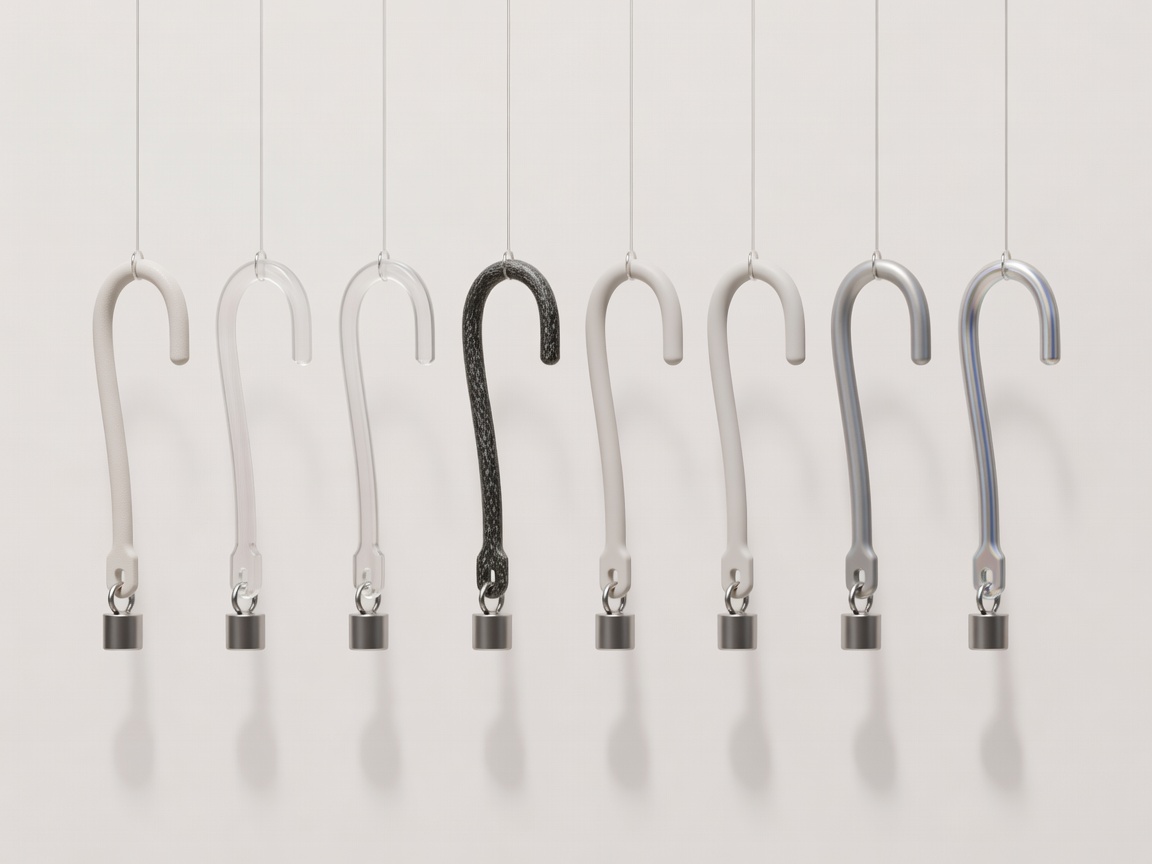
Same geometry4 walls · 25 % gyroid2 kg · 14 days
Identical hooks, identical settings, different materials: the cheapest comparison test in the workshop.
Layer Adhesion Is Part of the Material
A datasheet strength figure tells you little if the part fails between layers. Printed parts are anisotropic: strength along the extruded lines can be considerably higher than strength across layers. Materials and settings that bond layers well — PETG at a suitable temperature, ABS and ASA in an enclosure, reduced part cooling for structural walls — narrow that gap. Orientation still matters more than any material swap, which is why the mechanisms guide starts with print direction.
Moisture Changes the Material You Bought
Nylon, TPU and polycarbonate absorb water from the air, and PETG does so more slowly. Wet filament hisses and pops at the nozzle, produces bubbles and rough surfaces, prints weaker layers and drifts in dimension. Dry it according to the manufacturer's temperature guidance using a filament dryer, then store it sealed with desiccant. If a previously reliable profile suddenly strings and weakens, suspect moisture before you rewrite the settings.
Read the data sheet carefully. Manufacturers often test injection-moulded or optimally printed specimens to standards such as ISO 527 or ASTM D638. Those figures are useful for ranking materials, but they are not a prediction for your part, your orientation or your printer.
Test Hooks, Not Just Numbers
The most useful comparison is one you print. Model a simple hook or cantilever, print it in each candidate material with identical walls, infill and orientation, and hang a known weight. Measure deflection with calipers at the start, after one day and after two weeks. Note where and how each one breaks. Within a fortnight you have creep, stiffness and failure-mode data for your exact conditions.
Define — write the duty sentence and acceptance test.
Shortlist — pick two or three candidates from the matrix.
Dry — condition every spool the same way before testing.
Print — identical geometry, walls, infill and orientation.
Load & measure — record deflection on day 0, 1 and 14.
Decide — choose on measured results, then pick the colour.
“The spool label tells you what the material can do in a lab. The hook on your bench tells you what it will do in your shed.”Workshop note
When a material behaves unexpectedly, the diagnosis guide helps separate material faults from machine and design faults.